Compact 6-tray GN 1/1
For small kitchens, cafés and satellite outlets where footprint and fast heat-up matter most.
A combi oven is a programmable oven that combines convection heat with steam, so one unit can roast, bake, steam, poach, regenerate and hold food.
Combi ovens replace several single-purpose appliances and are usually the highest-value decision in a hotel or central kitchen. Capacity, steam generation and cleaning system drive the specification.
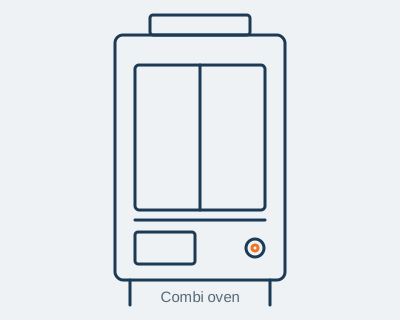
The model list is to be confirmed. These are the configuration families buyers most often request; send your required capacity and we will match them to current models.
For small kitchens, cafés and satellite outlets where footprint and fast heat-up matter most.
The most common format for restaurant and hotel à la carte service; stackable with a second unit.
Roll-in and high-capacity formats for banquet kitchens and central production.
Boiler systems give high steam volume for intensive production; injector systems reduce service complexity.
Values below are typical configuration ranges for the category, not a verified model specification.
| Parameter | Value / configuration |
|---|---|
| Tray capacity | 6 / 10 / 20 × GN 1/1; GN 2/1 roll-in formats available |
| Steam generation | Boiler or injection system, selected by production profile |
| Cooking modes | Convection, steam, combination, regeneration and holding |
| Typical temperature band | Approximately 30–300 °C depending on mode and configuration |
| Control | Programmable recipes, multi-step cycles and core-temperature probe option |
| Power supply | Electric three-phase, or gas-fired builds; voltage configured per market |
| Water and drainage | Filtered water inlet, drain and water-softening recommendation supplied with the build |
| Chamber material | 201 stainless steel with rounded, hygienic internal corners |
| Cleaning | Manual, semi-automatic or fully automatic wash system options |
| Compliance documentation | CE / UKCA, ETL / UL / NSF as applicable — verified copies on request |
| Verified model values | To be confirmed — supplied in the official spec sheet |
Typical configuration ranges only. Model-specific verified values, dimensions and certificate numbers are supplied in the official spec sheet on request.
Compliance requirements differ by destination. Confirm them before the quotation so the build, documents and price are correct the first time.
CE and UKCA documentation, 220–240V / 50Hz or three-phase supply. Water quality and drainage are specified at order stage; ask for the model-specific certificate copy.
ETL / UL / NSF references as applicable and 208/240V three-phase supply options. Confirm local plumbing and ventilation requirements with your installer.
220–240V / 50Hz or 380V three-phase, high-ambient operation and water treatment recommendations for hard-water locations.
Send your capacity, voltage, gas or refrigerant requirement and destination port. We will return matched models, compliance notes and a quotation.
Short, direct answers for buyers shortlisting this category.
A combi oven injects steam as well as dry heat, so it can steam, poach and regenerate food without drying it out. A convection oven only circulates dry hot air. Combi units suit mixed menus and batch regeneration; convection units suit dry baking and roasting.
Choose a boiler for high-volume steaming and intensive production; choose an injector for simpler maintenance and lower service complexity. We confirm it against your menu mix, water quality and available after-sales support.
Size from peak batch volume, not from average covers. A 6-tray unit suits small outlets, 10-tray units suit most à la carte kitchens, and 20-tray or roll-in formats suit banquet and central production. Share your covers and menu for a sizing recommendation.